
An Interface in Java is the same as a class, like any other class, an interface can have methods and Variables. But unlike a class, the method in it is an abstract method (only method signature, contain no body), and also by default, the declared variables in an interface are public, static & final.
Uses of Interfaces:
- It is used to achieve abstraction.
- As we have learned that Java does not support multiple inheritance but through the interface, we can achieve multiple inheritance.
- It is also used to achieve loose coupling.
Note: Abstraction cannot be used to create objects. Hence it cannot contain a constructor.
Declaring an Interface in Java:
The keyword ‘interface‘ is used to declare an interface. Syntax of Interface in Java:
interface interface_name
 {

  // declare constant fields, abstract methods

 }
Example of interface:
interface Dog
 {
    public void bark(); // interface method
    public void run(); // interface method
 }
Implementation of Interface in Java:
To implement an interface in a class, we use the keyword ‘implements’ The following example shows the use of implements. In the example below, the class Puppy implements the interface Dog.
interface Dog
 {
    public void bark(); // interface method
    public void eat(); // interface method
 }

 // implementing Dog
 class Puppy implements Dog
 {
    public void bark()
    {
    // Body of a bark() method
    System.out.println("Dog Barks");
    }
    public void eat()
    {
    // Body of a eat() method
    System.out.println("Dog eat Bones");
    }
 }

 public class MyMainClass
 {
    public static void main(String[] args)
    {
    Puppy pup = new Puppy();  //Puppy object
    pup.bark();
    pup.eat();
    }
 }
Output of Interfaces in Java:
Dog Barks
Dog eat Bones
Multiple Interfaces and inheritance in Java:
We know class in java allows only a single extends but with the use of interfaces, we can implement more than one parent interface.
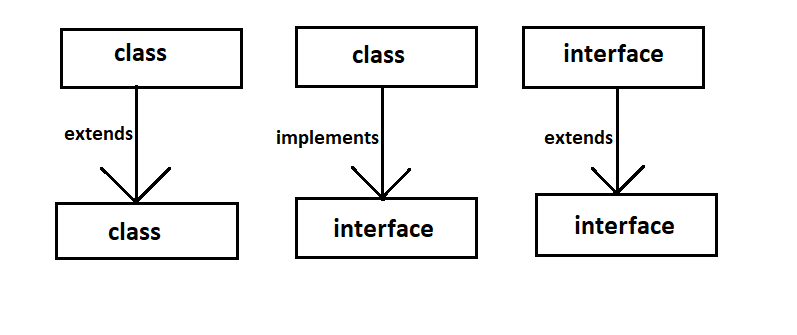
In the diagram above,
- The class extends a class
- The interface extends an interface
- class implements interface
Example of Multiple Interface in Java:
interface Interface1
 {
    public void firstMethod(); // interface method
 }

 interface Interface2
 {
    public void secondMethod(); // interface method
 }

 // InClass "implements" the above two interface
 class Inclass implements Interface1, Interface2
 {
    public void firstMethod()
    {
    System.out.println("Displaying first method");
    }
    public void secondMethod()
    {
    System.out.println("Displaying second method");
    }
 }

 public class MyMainClass
 {
    public static void main(String[] args)
    {
    Inclass Obj = new Inclass();
    Obj.firstMethod();
    Obj.secondMethod();
    }
 }
Output:
Displaying first method
Displaying second method