
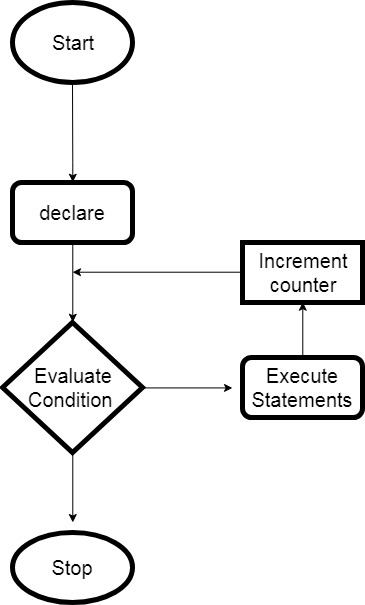
The Java for loop allows the user to iterate a part of the program multiple times. If a user is certain about how many specific numbers of times the loop must be executed then for loop is recommended. It is also an entry-control loop but here flow control contains three steps:
- initialization = The first step is the initialization of the variable and is executed only once. And need to end with a semicolon(;).
- condition = Second is condition check, it checks for a boolean expression. If true then enter the block and if false exit the loop. And need to end with a semicolon(;).
- Increment or Decrement = The third one is the increment or decrement of the variable for the next iteration. Here, we need to use the semicolon(;).
Flowchart of for loop in Java:
Syntax of for loop:
for(initialization; condition; Increment or Decrement)
 {
  // Statements
 }
Example of for loop in Java:
 public class ForTest
 {
  public static void main(String args[])
  {
    for(int a = 1; a < 10; a++)
    {
    System.out.println("value of a : " + a );
    }
  }
 }
Output:
 value of a : 1
 value of a : 2
 value of a : 3
 value of a : 4
 value of a : 5
 value of a : 6
 value of a : 7
 value of a : 8
 value of a : 9