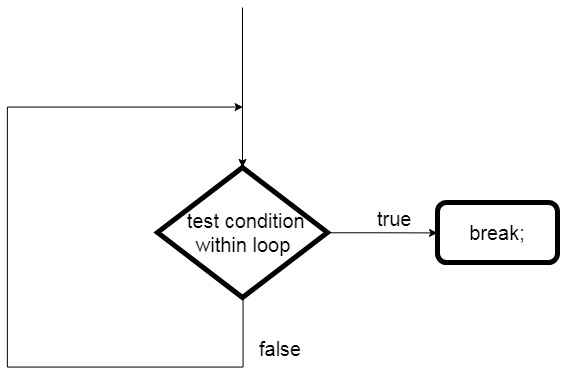
break statement terminates the loop and transfers the execution process immediately to a statement following the loop.
break statement is mostly used in a switch statement to terminate the cases present in a switch statement.
The use of break statements in nested loops terminates the inner loop and the control is transferred to the outer loop.
break statement Flowchart:
Syntax of break statement in C++:
break;Example on C++ break Statement
Example: C++ program to demonstrate the use of break statement in single loop.
#include <iostream>
using namespace std;

int main()
{
   for (int i = 1; i <= 10; i++)
   {
      if (i == 7)
      {
         //when i becomes 7 then it will come out of for loop
         break;
      }

      cout << "i is: " << i << endl;
   }
}
Output:
i is: 1
i is: 2
i is: 3
i is: 4
i is: 5
i is: 6
Example: C++ program for break statement used in nested loop.
//using break statement inside nested loop

#include <iostream>
using namespace std;

int main()
{
   // outer loop
   for (int i = 1; i <= 5; i++)
   {
     	//inner loop
      for (int j = 1; j <= 2; j++)
      {
         if (i == 4)
         {
            //if i becomes 4, it will come out of inner loop
            break;
         }

         cout << "i = " << i << ", j = " << j << endl;
      }
   }

   return 0;
}
Output:
i = 1, j = 1
i = 1, j = 2
i = 2, j = 1
i = 2, j = 2
i = 3, j = 1
i = 3, j = 2
i = 5, j = 1
i = 5, j = 2
In the above program, for the value i = 4 is skipped because when we reached i value as four, break statement is applied the execution came out of the inner loop, skipping the inner loop for 4.