In this article, you will learn about the C program to solve Dining Philosophers problem.
The Dining Philosophers Problem:
Let there be 5 philosophers (for example) sitting around a round table for dinner. Each philosopher needs two forks to eat but there are only 5 forks (equal to the number of philosophers around the table).
A philosopher may eat if he/she can pick up two adjacent forks. But the 5 philosophers cannot eat at the same time because they can have only 1 fork on one hand and empty on the other and not able to eat. After that, each of them waits for the adjacent philosopher to finish which leads to a deadlock situation and each of the philosophers starve.
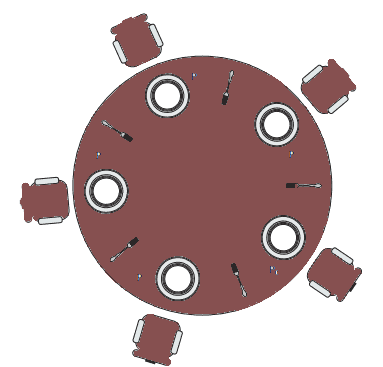
The problem is to create a behaviour (algorithm) for the philosophers such that each philosopher would not starve and able to alternate between eating and thinking.
Program for Dining Philosophers Problem in C
#include <stdio.h>
#define n 5	//Number of philosophers around the table

int completedPhilosophers = 0, i;

struct fork
{
  int taken;
}

ForkAvail[n];

struct philosp
{
  int left;
  int right;
}

Philostatus[n];

void goForDinner(int philID)
{
 	//same like threads concept here cases implemented
  if (Philostatus[philID].left == 10 && Philostatus[philID].right == 10)
    printf("Philosopher %d completed his dinner\n", philID + 1);
 	//if already completed dinner
  else if (Philostatus[philID].left == 1 && Philostatus[philID].right == 1)
  {
   	//if just taken two forks
    printf("Philosopher %d completed his dinner\n", philID + 1);

    Philostatus[philID].left = Philostatus[philID].right = 10;	//remembering that he completed dinner by assigning value 10
    int otherFork = philID - 1;

    if (otherFork == -1)
      otherFork = (n - 1);

    ForkAvail[philID].taken = ForkAvail[otherFork].taken = 0;	//releasing forks
    printf("Philosopher %d released fork %d and fork %d\n", philID + 1, philID + 1, otherFork + 1);
    completedPhilosophers++;
  }
  else if (Philostatus[philID].left == 1 && Philostatus[philID].right == 0)
  {
   	//left already taken, trying for right fork
    if (philID == (n - 1))
    {
      if (ForkAvail[philID].taken == 0)
      {
       	//KEY POINT OF THIS PROBLEM, THAT LAST PHILOSOPHER TRYING IN reverse DIRECTION
        ForkAvail[philID].taken = Philostatus[philID].right = 1;
        printf("Fork %d taken by philosopher %d\n", philID + 1, philID + 1);
      }
      else
      {
        printf("Philosopher %d is waiting for fork %d\n", philID + 1, philID + 1);
      }
    }
    else
    {
     	//except last philosopher case
      int dupphilID = philID;
      philID -= 1;

      if (philID == -1)
        philID = (n - 1);

      if (ForkAvail[philID].taken == 0)
      {
        ForkAvail[philID].taken = Philostatus[dupphilID].right = 1;
        printf("Fork %d taken by Philosopher %d\n", philID + 1, dupphilID + 1);
      }
      else
      {
        printf("Philosopher %d is waiting for Fork %d\n", dupphilID + 1, philID + 1);
      }
    }
  }
  else if (Philostatus[philID].left == 0)
  {
   	//nothing taken yet
    if (philID == (n - 1))
    {
      if (ForkAvail[philID - 1].taken == 0)
      {
       	//KEY POINT OF THIS PROBLEM, THAT LAST PHILOSOPHER TRYING IN reverse DIRECTION
        ForkAvail[philID - 1].taken = Philostatus[philID].left = 1;
        printf("Fork %d taken by philosopher %d\n", philID, philID + 1);
      }
      else
      {
        printf("Philosopher %d is waiting for fork %d\n", philID + 1, philID);
      }
    }
    else
    {
     	//except last philosopher case
      if (ForkAvail[philID].taken == 0)
      {
        ForkAvail[philID].taken = Philostatus[philID].left = 1;
        printf("Fork %d taken by Philosopher %d\n", philID + 1, philID + 1);
      }
      else
      {
        printf("Philosopher %d is waiting for Fork %d\n", philID + 1, philID + 1);
      }
    }
  }
  else {}
}

int main()
{
  for (i = 0; i < n; i++)
    ForkAvail[i].taken = Philostatus[i].left = Philostatus[i].right = 0;

  while (completedPhilosophers < n)
  {
    /*
    Actually problem of deadlock occur only they try to take at same time
    This for loop will say that they are trying at same time.
    And remaining status will print by go for dinner function
    */
    for (i = 0; i < n; i++)
      goForDinner(i);
    printf("\nTill now number of philosophers who completed dinner are: %d", completedPhilosophers);
  }

  return 0;
}
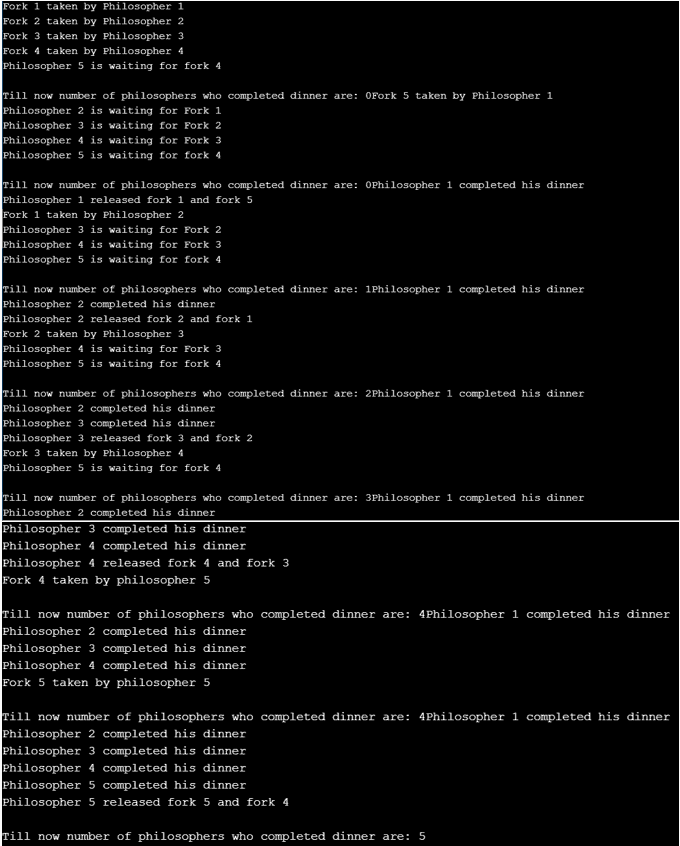
The output of the Dining philosopher problem in c programming: