In this tutorial, the program finds out the solutions to the simultaneous equations in two variables. The Linear equations are present in the following form:
- ax+by=c
- px+qy=r
The co-efficient (a, b, c, p, q, r) are taken as an input from the user for the two equations.
C Program to solve Simultaneous Linear Equations in two variables
Source Code:
#include <stdio.h>

int main()
{
  double a, b, c, p, q, r, x, y;

  //Taking inputs of co-efficient for both equations
  printf("Enter the coefficents of the first equation of the form ax+by=c\n");
  scanf("%lf %lf %lf", &a, &b, &c);

  printf("Enter the coefficents of the second equation of the form px+qy=r\n");
  scanf("%lf %lf %lf", &p, &q, &r);

  if (((a*q - p *b) != 0) && ((b*p - q*a) != 0))
  {
    //In this case we have a unique solution and display x and y
    printf("The solution to the equations is unique\n");
    x = (c*q - r*b) / (a*q - p*b);
    y = (c*p - r*a) / (b*p - q*a);

    //Displaying the value
    printf("The value of x=%lf\n", x);
    printf("The value of y=%lf\n", y);
  }
  else
  if (((a*q - p*b) == 0) && ((b*p - q*a) == 0) && ((c*q - r*b) == 0) && ((c*p - r*a) == 0))
  {
    printf("Infinitely many solutions are possible\n");
    printf("The value of x can be varied and y can be calculated according to x's value using relation\n");
    printf("y=%lf+(%lf)x", (c/b), (-1*a/b));
  }
  else
    //No possible solution.
    if (((a*q - p*b) == 0) && ((b*p - q*a) == 0) && ((c*q - r*b) != 0) && ((c*p - r *a) != 0))
      printf("No Possible solution\n");
  getch();
}
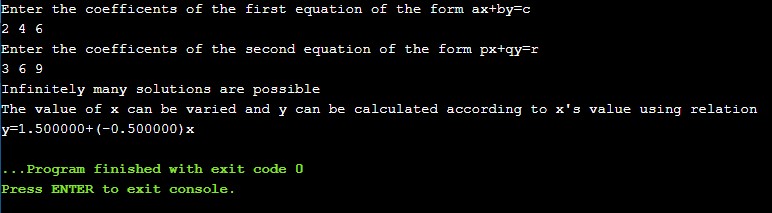
Let us see two outputs with two different inputs of two equation:
Output1:
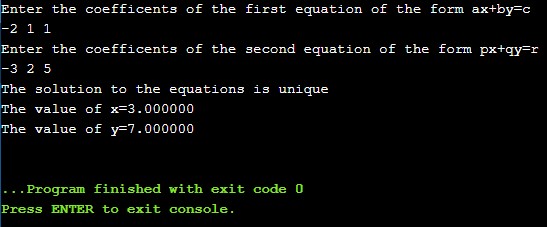
Output2: