Blog

  • Java Program to Check if the given number is Emirp Number or not

    In this tutorial of Emirp Number in Java, we will write a program to check for the Emirp number in Java. Let us start by understanding, what is Emirp number.

    Emirp Number

    A number is said to be an Emirp number if it is a prime number and when reversed, the result formed is also a Prime Number. Emirp is backward for Prime, which indicates that a number, when formed backward, is also a prime number. Hence also known as twisted prime numbers.

    Example: 13, 79, 199, 107 etc.

    Explanation: Consider a Prime Number, 13
    The reverse of 13: 31, which is also a prime number. Therefore, 13 is an Emirp Number.


    Java Program to check for Emirp Number Using Function.

    import java.io.*;
    import java.util.*;
    
    public class EmirpNumber
    {
       //function to check for prime, returns boolean
       public static boolean isPrime(int n)
       {
          if (n <= 1)
             return false;
    
          for (int i = 2; i < n; i++)
          {
             if (n % i == 0)
                return false;
          }
    
          return true;
       }
    
       //function to check for emirp number, returns boolean
       public static boolean isEmirp(int n)
       {
          //calls isPrime function and checks for prime
          if (isPrime(n) == false)
             return false;
    
          int rev = 0;
          while (n != 0)
          {
             int digit = n % 10;
             rev = rev *10 + digit;
    
             n = n / 10;
          }
    
          //after reverse again checks for prime  
          return isPrime(rev);
       }
    
       //main function
       public static void main(String args[])
       {
          Scanner sc = new Scanner(System.in);
    
          System.out.print("Enter a number: ");
          int n = sc.nextInt();
    
          //Display accordingly
          if (isEmirp(n) == true)
             System.out.println(n + " is an Emirp number.");
          else
             System.out.println(n + " is not an Emirp number.");
       }
    }

    Output:

    //First Run
    Enter a number: 13
    13 is an Emirp number.

    //Second Run
    Enter a number: 107
    107 is an Emirp number.

    //Third Run
    Enter a number: 23
    23 is not an Emirp number.

  • Autobiographical Number in Java

    In this tutorial, we will write an Autobiographical Number Program in Java and also learn what is Autobiographical Number.

    Autobiographical Number

    An autobiographical number is a number such that the first digit of it counts how many zeroes are there in it, the second digit counts how many ones are there, and so on. Basically, it counts the frequency of digits from 0 to 9 in order which they occur in a number.

    Example: 1210 has 1 zero, 2 ones, 1 two, and 0 threes.
    Some other examples include 2020, 21200, 3211000, 42101000, etc.

    Explanation: Consider a number, 21200.

    First, the sum of the digits: 2+1+2+0+0 = 5
    Second, count the number of digits: 5
    Since the sum of the digits is equal to the number of digits present in a number. Therefore, 21200 is an autobiographical number.


    Java Program to check if the given number is Autobiographical Number or not

    import java.util.*;
    
    public class AutobiographicalNumber
    {
       public static void main(String args[])
       {
          int num, n;
          String str;
          boolean flag;
          Scanner sc = new Scanner(System.in);
          
          System.out.print("Enter the number: ");
          num = sc.nextInt();
          
          num = Math.abs(num);
          n = num;
          
          str = String.valueOf(num);
    
          int digitarray[] = new int[str.length()];
          for (int i = digitarray.length - 1; i >= 0; i--)
          {
             digitarray[i] = n % 10;
             n = n / 10;
          }
    
          flag = true;
          
          for (int i = 0; i < digitarray.length; i++)
          {
             int count = 0;
             for (int j = 0; j < digitarray.length; j++)
             {
                if (i == digitarray[j])
                   count++;
             }
    
             if (count != digitarray[i])
             {
                flag = false;
                break;
             }
          }
    
          if (flag)
             System.out.println(num + " is an Autobiographical number.");
          else
             System.out.println(num + " is not an Autobiographical number.");
       }
    }

    Output:

    //First Run
    Enter the number: 1210
    1210 is an Autobiographical number.

    \\Second Run
    Enter the number: 1410
    1410 is not an Autobiographical number.


  • Java Program to Display the ATM Transaction

    In this tutorial, we will write an ATM program in Java. The program will represent the ATM transaction executed.

    Operation available in the ATM Transaction are:

    1. Withdraw
    2. Deposit
    3. Check Balance
    4. Exit

    The user will choose one of the above operations:

    • Withdraw is to withdraw the amount from an ATM. The user is asked to enter the amount and after the withdrawal process is complete, we need to remove that amount from the total balance.
    • Deposit is to add an amount to the total balance, here also the user enters the amount to be added to the total balance.
    • Check Balance means simply display the total balance available in the user’s account.
    • Exit is to return the user to the main page from the current transaction mode. For that, we will use exit(0).

    ATM program Java

    The following program uses the switch statement in java to create a case for each transaction or option.

    import java.util.Scanner;
    
    public class ATMProgram
    {
      public static void main(String args[])
      {
        int balance = 5000, withdraw, deposit;
        Scanner sc = new Scanner(System.in);
    
        while (true)
        {
          System.out.println("ATM (Automated Teller Machine)");
          System.out.println("Choose 1 for Withdraw");
          System.out.println("Choose 2 for Deposit");
          System.out.println("Choose 3 for Check Balance");
          System.out.println("Choose 4 for EXIT");
          System.out.print("Choose the operation you want to perform: ");
    
          //user choice input 
          int choice = sc.nextInt();
          switch (choice)
          {
            case 1:
              System.out.print("Enter the amount to be withdrawn: ");
              withdraw = sc.nextInt();
    
              //balance need to be with the withdrawn amount  
              if (balance >= withdraw)  //for successful transaction 
              {
                balance = balance - withdraw;
                System.out.println("Withdrawal successful! Please collect your money.");
              }
              else	//not enough balance
              {
                System.out.println("Insufficient Balance");
              }
    
              System.out.println("");
              break;
    
            case 2:
              System.out.print("Enter amount to be deposited: ");
              deposit = sc.nextInt();
    
              //adding to the total balance 
              balance = balance + deposit;
              System.out.println("Your Money has been successfully depsited:");
              System.out.println("");
              break;
    
            case 3:
              //balance check 
              System.out.println("Available Balance: " + balance);
              System.out.println("");
              break;
    
            case 4:
              //for exit 
              System.out.println("Successfully EXIT.");
              System.exit(0);
          }
        }
      }
    }

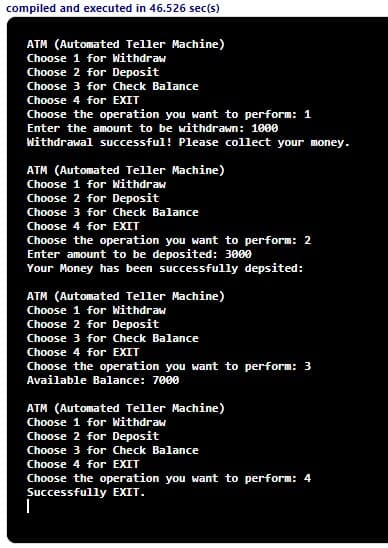
    Output:

    ATM Program Java

  • Spy Number in Java

    In this tutorial, we will write java programs to check for Spy Numbers. We will look at two different java programs son Spy Number

    1. Java Program to Check If a Number is Spy number or not.
    2. Java Program to print all the Spy Number within a given Range.

    What is Spy Number?

    A number is said to be a spy number if the sum of all its digits is equal to the product of all its digits.
    Example:

    Number: 123 
    Sum of its digits: 1+2+3 = 6
    Product of its digits: 1*2*3 = 6  
    Sum and Product are equal, hence, 123 is a Spy number.

    Similarly, you may check for other numbers such as 22, 132, 1124, etc.


    Spy Number in Java Program

    1. Java Program to Check If a Number is Spy number or not

    import java.util.Scanner;
    
    public class SpyNumber
    {
       public static void main(String args[])
       {
          int num, product = 1, sum = 0, lastdigit;
          Scanner sc = new Scanner(System.in);
    
          //read from user
          System.out.print("Enter the number: ");
          num = sc.nextInt();
    
          int number = num;
    
          //calculation for sum and product 
          while (num > 0)
          {
             lastdigit = num % 10;
    
            	//calculating sum
             sum = sum + lastdigit;
            	//calculating product
             product = product * lastdigit;
    
             num = num / 10;
          }
    
          //compares the sum and product and print the result
          if (sum == product)
             System.out.println(number + " is a spy number.");
          else
             System.out.println(number + " not a spy number.");
       }
    }

    Output:

    //First Run
    Enter the number: 1124
    1124 is a spy number.

    //Second Run
    Enter the number: 166
    166 not a spy number.


    2. Java Program to print all the Spy Number within a given Range.

    We will create a separate Boolean function (isSpyNumber()) that will return true if the sum of the digits and the product of the digits are equal else will return false and print them accordingly.

    The program takes the input for the lower range and upper range value and will pass those numbers between this range to the function as an argument.

    import java.util.Scanner;
    
    public class SpyNumber
    {
       private static boolean isSpyNumber(int number)
       {
          int lastdigit = 0;
          int sum = 0, product = 1;
    
          //calculation  
          while (number != 0)
          {
             lastdigit = number % 10;
    
            	//calculating sum
             sum = sum + lastdigit;
            	//calculating product
             product = product * lastdigit;
    
             number = number / 10;
          }
    
          //comapre and return true value if found equal  
          if (sum == product)
             return true;
    
          return false;
       }
    
       public static void main(String args[])
       {
          int lwRange, upRange;
          Scanner sc = new Scanner(System.in);
    
          //read from user
          System.out.print("Enter the Lower Range: ");
          lwRange = sc.nextInt();
          System.out.print("Enter the Upper Range: ");
          upRange = sc.nextInt();
    
          System.out.println("The Spy numbers between " + lwRange + " and " + upRange + " are: ");
          for (int i = lwRange; i <= upRange; i++)
          {
             //calling function at each iteration, that is for each number within the range
             if (isSpyNumber(i))
                System.out.print(i + " ");
          }
       }
    }

    Output:

    Enter the Lower Range: 1
    Enter the Upper Range: 1000
    The Spy numbers between 1 and 1000 are:
    1 2 3 4 5 6 7 8 9 22 123 132 213 231 312 321


  • C Program to Check if a Given String is a Palindrome

    In this tutorial, we will write a C program to Check if a Given String is a Palindrome using string function. Before that, you may go through the C topic below.

    Palindrome Number

    A number is said to be a Palindrome number if it remains the same when its digits are reversed or are the same as forward. It is also applied to the word, phrase or other sequences of symbols.

    For example: If we take the example of ‘mam‘ or ‘madam‘, these are also palindrome words as we will get the same result even if we write it backward.


    C Program to Check if a Given String is a Palindrome

    The program uses one of the string functions that is strlen() function that returns the length of the string. And the header string.h is included to use this function.

    #include <stdio.h>
    #include <string.h>
    
    int main()
    {
       char str[30], flag = 0;
       int i, length;
    
       printf("Enter the string:");
       gets(str);
    
       //strlen() function is used
       length = strlen(str);
    
       for (i = 0; i < length / 2; i++)
       {
          if (str[i] != str[length - 1 - i])
          {
             flag = 1;
             break;
          }
       }
    
       if (flag == 0)
          printf("%s :- is a palindrome.", str);
       else
          printf("%s :- is not a palindrome.", str);
    
       return 0;
    }

    Output:

    //First Run
    Enter the String:
    madam
    madam :- is a palindrome.

    //Second Run
    Enter the String:
    step on no pets
    step on no pets :- is a palindrome.

    //Thirsd Run
    Enter the String:
    how are you
    how are you :- is not a palindrome.


  • C Program to check for String Palindrome without using string functions

    In this tutorial, we will write a C program to read a string and check for palindrome without using string related function. Before that, you may go through the C topic below.

    What is a Palindrome Number or String?

    A number is said to be a Palindrome number if it remains the same when its digits are reversed or are the same as forward. It is also applied to the word, phrase or other sequences of symbols.

    For example: 14141, 777, 272 are palindrome numbers as they remain the same even if reversed. If we take the example of ‘mam‘ or ‘madam‘, these are also palindrome words as we will get the same result even if we write it backward.


    C Program to check a given string is palindrome without using the Built-in Function

    #include <stdio.h>
    
    int main()
    {
       char string[50], length = 0;
       int flag = 1, i;
    
       printf("Enter the String:\n");
       gets(string);
    
       //\0 represent for string is ended
       for (i = 0; string[i] != '\0'; i++)
       {
          length++;
       }
    
       for (i = 0; i < length / 2; i++)
       {
          if (string[i] != string[length - 1 - i])
          {
             flag = 0;
             break;
          }
       }
    
       if (flag == 1)
          printf("%s :- is a palindrome.", string);
       else
          printf("%s :- is not a palindrome.", string);
    
       return 0;
    }

    Output:

    //First Run
    Enter the String:
    madam
    madam :- is a palindrome.

    //Second Run
    Enter the String:
    step on no pets
    step on no pets :- is a palindrome.

    //Thirsd Run
    Enter the String:
    how are you
    how are you :- is not a palindrome.


  • C Program to Multiply Two Matrices

    In this section, we will write a C Program to Multiply Two Matrices using multi-dimensional array. You may go through the c topics below, before starting.


    Matrix multiplication in C: We can add, subtract, multiply or divide two matrices in C. The program takes inputs for the numbers of rows and columns and elements themselves. And then we perform the multiplication operation using for loop in C.

    The matrix multiplication is done by multiplying the first matrix one-row element with the second matrix all column elements.

    NOTE: Condition for multiplication of matrix:- the number of columns of the first matrix should be equal to the number of rows of the second matrix.


    C Program for Matrix Multiplication

    We will take the rows and columns values once from the user for both the matrices.

    #include <stdio.h>
    
    int main()
    {
       int a[10][10], b[10][10], mul[10][10], r, c, i, j, k;
    
       printf("Enter the number of ROWS: ");
       scanf("%d", &r);
       printf("Enter the number of COLUMNS: ");
       scanf("%d", &c);
    
       printf("\nEnter the element for the FIRST matrix: \n");
       for (i = 0; i < r; i++)
       {
          for (j = 0; j < c; j++)
          {
             printf("a[%d][%d] = ", i, j);
             scanf("%d", &a[i][j]);
          }
       }
    
       printf("\nEnter the element for the SECOND matrix: \n");
       for (i = 0; i < r; i++)
       {
          for (j = 0; j < c; j++)
          {
             printf("b[%d][%d] = ", i, j);
             scanf("%d", &b[i][j]);
          }
       }
    
       printf("\nMatrix Multiplication: \n");
       for (i = 0; i < r; i++)
       {
          for (j = 0; j < c; j++)
          {
             mul[i][j] = 0;
             for (k = 0; k < c; k++)
             {
                mul[i][j] += a[i][k] *b[k][j];
             }
          }
       }
    
       //print the result   
       for (i = 0; i < r; i++)
       {
          for (j = 0; j < c; j++)
          {
             printf("%d\t", mul[i][j]);
          }
    
          printf("\n");
       }
    
       return 0;
    }

    Output:

    Enter the number of ROWS: 2
    Enter the number of COLUMNS: 2

    Enter the element for the FIRST matrix:
    a[0][0] = 2
    a[0][1] = 2
    a[1][0] = 2
    a[1][1] = 2

    Enter the element for the SECOND matrix:
    b[0][0] = 3
    b[0][1] = 3
    b[1][0] = 3
    b[1][1] = 3

    Matrix Multiplication:
    12 12
    12 12


  • C Program to Access an element in 2-D Array

    In this tutorial, we will write a Program to access an element in 2D Array in C. Before that, you should have knowledge of the following C programming topics.

    Accessing Array Elements

    2D Array is of 2 Dimensional, one determines the number of rows and another is for columns.
    Example: arr[0][1] refers element belonging to the zeroth row and first column in a 2D array.

    • For accessing an elemnt, we need two Subscript variables (i, j).
    • i = number of rows.
    • j = number of columns.

    C Program to access the 2D Array element

    #include <stdio.h>
    
    int main()
    {
       int i, j, arr[3][3];
    
       printf("Enter the element for each row and column:\n");
       for (i = 0; i < 3; i++)
       {
          for (j = 0; j < 3; j++)
          {
             printf("arr[%d][%d] = ", i, j);
             scanf("%d", &arr[i][j]);
          }
       }
    
       //Display array
       printf("\nElement present in an Array:\n");
    
       for (i = 0; i < 3; i++)
       {
          for (j = 0; j < 3; j++)
          {
             printf("%d\t", arr[i][j]);
          }
    
          printf("\n");
       }
    
       return (0);
    }

    Output:

    Enter the element for each row and column:
    arr[0][0] = 1
    arr[0][1] = 2
    arr[0][2] = 3
    arr[1][0] = 4
    arr[1][1] = 5
    arr[1][2] = 6
    arr[2][0] = 7
    arr[2][1] = 8
    arr[2][2] = 9
    
    Element present in an Array:
    1	2	3	
    4	5	6	
    7	8	9

  • C Program for deletion of an element from the specified location from Array

    In this tutorial, we will write a C program to delete elements from an array at a specified position. We will specifically learn two different programs:

    1. Delete an element by specifying the position.
    2. Delete an element by specifying the value.

    Example: By position.

    Input
    Input array elements: 11 22 30 42 50
    Specify the position to delete: 3

    Output
    Array elements: 11 22 42 50

    Example: By Value.

    Input
    Input array elements: 11 22 30 42 50
    Specify the value to delete: 22

    Output
    Array elements: 11 30 42 50

    Before that, you should have knowledge on the following C topics:


    C program to delete an element from an array at specified position

    Explanation: The position of an element to be removed is entered. Then using loop traverse to that position. Once you get to the specified position, shift all the elements from index + 1 by 1 position to the left.

    And if the position is not present that is the number of elements present in an array is 5 but the user entered the 6th position to delete, in that case, the program will display the message “Position Not Valid”.

    #include <stdio.h>
    
    int main()
    {
       int arr[50], pos, i, size;
    
       printf("Enter the size of an array: ");
       scanf("%d", &size);
    
       printf("Enter %d elements in an array:\n", size);
       for (i = 0; i < size; i++)
          scanf("%d", &arr[i]);
    
       printf("Array before deletion of element:\n");
       for (i = 0; i < size; i++)
          printf("%d  ", arr[i]);
    
       printf("\n\nEnter the location of the element to delete: ");
       scanf("%d", &pos);
    
       if (pos >= size + 1)
          printf("Entered Position Not Valid");
       else
          for (i = pos - 1; i < size - 1; i++)
             arr[i] = arr[i + 1]; //Location shifted
    
       printf("\nArray after deletion of element:\n");
       for (i = 0; i < size - 1; i++)
          printf("%d  ", arr[i]);
    
       return 0;
    }

    Output:

    Enter the size of an array: 5
    Enter 5 elements in an array:
    10
    20
    30
    40
    50
    Array before deletion of element:
    10  20  30  40  50  
    
    Enter the location of the element to delete: 2
    Array after deletion of element:
    
    10  30  40  50   

    C Program to delete Element in an Array by specifying the Value

    Explanation: Here instead of a position of an element, the value of the element is specified to delete. Similarly, the program traverse until the element is found and then shifts all the elements from index + 1 by 1 position to the left.

    And if the value is not that is the entered value does not match with any element present in an array, in that case, the program will display the message “Element Not Valid”.

    #include <stdio.h>
    
    int main()
    {
       int arr[50], element, i, size, pos;
       int element_found = 0;
    
       printf("Enter the size of an array: ");
       scanf("%d", &size);
    
       printf("Enter %d elements\n", size);
    
       for (i = 0; i < size; i++)
          scanf("%d", &arr[i]);
    
       printf("\nArray before Deletion:\n");
       for (i = 0; i < size; i++)
          printf("%d ", arr[i]);
    
       printf("\n\nEnter the element to be deleted: ");
       scanf("%d", &element);
    
       // check the element to be deleted is in array or not
       for (i = 0; i < size; i++)
       {
          if (arr[i] == element)
          {
             element_found = 1;
             pos = i;
             break;	// terminate the loop
          }
       }
    
       if (element_found == 1)  // for element exists
       {
          for (i = pos; i < size - 1; i++)
             arr[i] = arr[i + 1];
       }
       else	//for element does not exists
          printf("\nElement %d is not present in an Array. Try Again!", element);
    
       printf("\nArray after Deletion:\n");
       for (i = 0; i < size - 1; i++)
          printf("%d  ", arr[i]);
    
       return 0;
    }

    Output:

    Enter the size of an array: 5
    Enter 5 elements
    10
    20
    30
    40
    50
    
    Array before Deletion:
    10 20 30 40 50 
    
    Enter the element to be deleted: 30
    
    Array after Deletion:
    10 20 40 50

  • Program to Reverse the Array Elements in C

    In this tutorial, we will learn C Program to Reverse an Array element. Before continuing, you should have knowledge of the following topics in C programming.

    Revering an array element: The entered array of integers will be reversed and displayed. Example:

    Input:
    arr = {1, 2, 3, 4, 5, 6}

    Output:
    Reversed arr: {6, 5, 4, 3, 2, 1}

    Here, we will look at two different programs to Reverse an Array element in C.

    1. By standard method
    2. By creating a function and swapping.

    C Program to print the elements of an array in reverse order

    #include <stdio.h>
    
    int main()
    {
       //Initialize array     
       int arr[50], size, i;
    
       printf("Enter the size for an array: ");
          scanf("%d", &size);
    
       printf("Enter %d elements of an array:\n", size);
       for (i = 0; i < size; i++)
          scanf("%d", &arr[i]);
    
       printf("Original order of an Array:\n");
       for (i = 0; i < size; i++)
       {
          printf("%d ", arr[i]);
       }
    
       printf("\nReversed order of an array:\n");
       for (i = size - 1; i >= 0; i--)
       {
          printf("%d ", arr[i]);
       }
    
       return 0;
    }

    Output:

    Enter the size for an array: 5
    Enter 5 elements of an array:
    10
    20
    30
    40
    50
    Original order of an Array:
    10 20 30 40 50
    Reversed order of an array:
    50 40 30 20 10


    C Program to to Reverse the Array Elements using Function

    This program has a separate function(rev_Array()) to reverse the element in an array. The reversing of elements is done by swapping array elements.

    #include <stdio.h>
    
    void rev_Array(int arr[], int size)
    {
       int temp, i = 0;
    
       //swapping
       while (i < size)
       {
          temp = arr[i];
          arr[i] = arr[size];
          arr[size] = temp;
          i++;
          size--;
       }
    }
    
    int main()
    {
       //Variables     
       int arr[50], size, i;
    
       //user inputs
       printf("Enter the size for an array: ");
          scanf("%d", &size);
       printf("Enter %d elements of an array:\n", size);
       for (i = 0; i < size; i++)
          scanf("%d", &arr[i]);
    
       printf("Original order of an Array:\n");
       for (i = 0; i < size; i++)
          printf("%d ", arr[i]);
    
       //calling reverse function
       rev_Array(arr, size - 1);
    
       //printing the reversed order
       printf("\nReversed order of an Array:\n");
       for (i = 0; i < size; i++)
          printf("%d ", arr[i]);
    
       return 0;
    }

    Output:

    Enter the size for an array: 5
    Enter 5 elements of an array:
    20
    30
    40
    60
    80
    Original order of an Array:
    20 30 40 60 80
    Reversed order of an Array:
    80 60 40 30 20