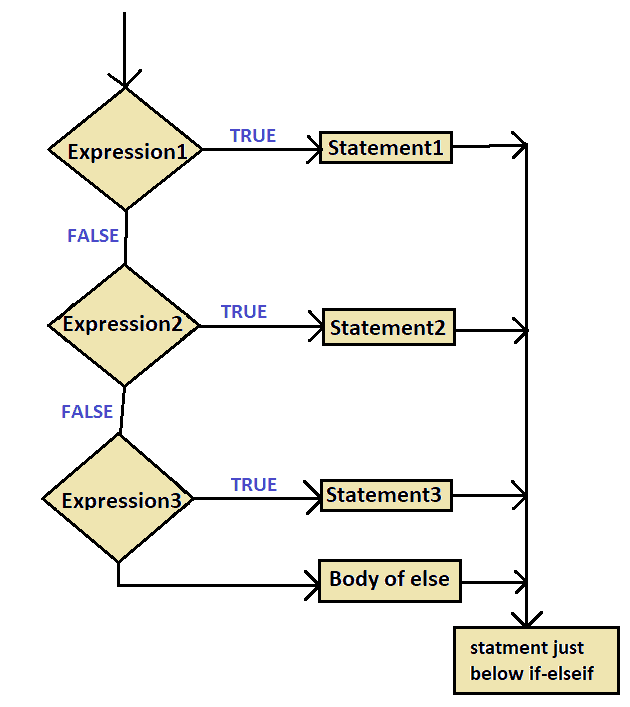
This statement allows the user to have multiple options to check for different conditions. Here, if one of the if or else-if condition is true then that part of the code will be executed and the rest will be skipped. if none of the conditions are true then the final else statement present at the end will be executed.
The syntax of the if-else-if ladder statement in C++:
 if(condition1)
 {
   //code to be executed if condition1 is true
 }
 else if(condition2){
   //code to be executed if condition2 is true
 }
 else if(condition3){
   //code to be executed if condition3 is true
 }
   ...
 else{
    //final else if all the above condition are false
 }
Flowchart diagram for if-else if statement:
Example of C++ if-else-if ladder statement
#include <iostream>
using namespace std;

int main()
{
   int a = 100;

  	// check condition
   if (a > 50)
   {
      cout << "Value of a less than 10." << endl;
   }
   else if (a == 10)
   {
      cout << "Value of a is equal to 20." << endl;
   }
   else if (a < 30)
   {
      cout << "Value of a is greater than 30." << endl;
   }
   else
   {
      cout << "None of the condition is true" << endl;
   }

   cout << "Value of a: " << a << endl;

   return 0;
}
This statement allows the user to use if block inside the other if block. And the inner if statement is executed only if the outer if statement’s condition is true.
The syntax of the nested if statement in C++:
if(condition1)
{
   //block of code to be executed
   if(condition2)
   {
     //block of code to be executed
   }
}
You can also nest the if..else statement in same manner as shown below.
//Nested if....else statement

if(condition1)
{
    if(condition2)
    {
        //block of statement;
    }
    else
    {
        //block of statement;
    }
}
else
{
    //block of statement;
}
nested if statement Flowchart:
nested if
Example of nested if statement in C++
#include <iostream>
using namespace std;

int main()
{
   int a = 50;
   int b = 110;

  	// check condition
   if (a < 100)
   {
     	// agian the use of if
      if (b < 200)
      {
         cout << "Value of a and b are 50 and 110 respectively" << endl;
      }
   }

   cout << "Value of a is: " << a << endl;
   cout << "Value of b is: " << b << endl;

   return 0;
}
Output:
Value of a and b are 50 and 110 respectively
Value of a is: 50
Value of b is: 110
Example of C++ nested if…else statement
#include <iostream>
using namespace std;

int main()
{
   int a, b, c;

   cout << "Enter 3 integers: ";
   cin >> a >> b >> c;

   if (a > b)
   {
      if (a > c)
      {
         cout << a << " is greatest of all.";
      }
      else
      {
         cout << c << " is greatest of all.";
      }
   }
   else
   {
      if (b > c)
      {
         cout << b << " is greatest of all.";
      }
      else
      {
         cout << c << " is greatest of all.";
      }
   }
}
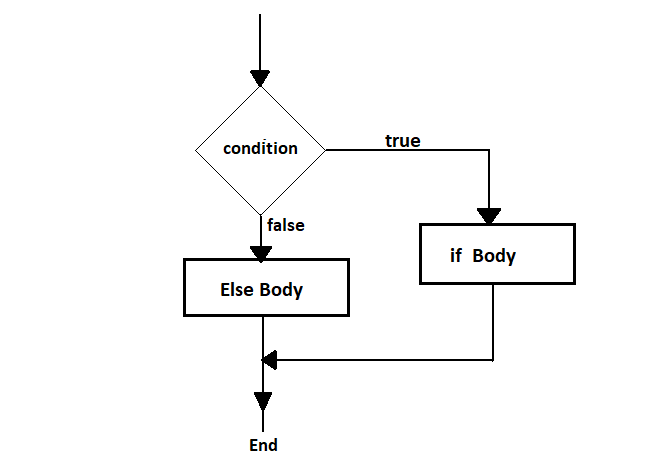
If the Boolean expression is true then the code inside the if statement block is executed or if it is false then the code inside else statement will be executed. Hence if..else statement.
The syntax of the if..else statement in C++:
 if (condition)
 {
  //code executed if condition true
 }
 else
 {
  //code executed if condition false
 }
If…else Flowchart:
if…else
Example of if…else statement in C++
#include <iostream>
using namespace std;

int main()
{
   int x = 50;

   // check condition
   if (x < 20)
   {
      //condition is true
      cout << "x is less than 20;" << endl;
   }
   else
   {
      //condition is false
      cout << "x is not less than 20;" << endl;
   }

   cout << "value of x: " << x << endl;

   return 0;
}
An if statement consists of a Boolean expression followed by one or more statements. If the Boolean expression is true, the block of code inside the if statement will be executed else not. This is most simple of all the decision making statements.
The syntax of the if statement in C++:
if (condition)
{
   //block of statement
}
If the condition is evaluated true, block of statement is executed.
If the condition is evaluated false, block of statement is skipped.
if statementFlowchart:
if statement
Example of C++ if statement:
#include <iostream>
using namespace std;

int main()
{
   int x = 100;

   //check the Boolean condition
   if (x < 200)
   {
      //if true, following will be displayed
      cout << "x is less than 200;" << endl;
   }

   cout << "value of x: " << x << endl;

   return 0;
}
It is important that before programming you should know the C# Keywords and Identifiers. You need to know that keywords cannot be used as identifiers and more.
C# Keywords
There are some predefined and reserved words that have special meanings to the compiler. These words are called Keywords. The meaning of the keywords in C# cannot be changed nor can you use them as an identifier. Some of the keywords that you see in a program are int, float, public, etc.
For Example:
//Valid way to write keyword
int phNumber;
long cardNumber;
float @float;

//Invalid way to write keyword
int int;
float double;
There are 79 keywords in C#. All the keywords are written in lowercase.
List of C# keywords
abstract
as
base
bool
break
byte
case
catch
char
checked
class
const
continue
decimal
default
delegate
do
double
else
enum
event
explicit
extern
false
finally
fixed
float
for
foreach
goto
if
implicit
in
in (generic modifier)
int
interface
internal
is
lock
long
namespace
new
null
object
operator
out
out (generic modifier)
override
params
private
protected
public
readonly
ref
return
sbyte
sealed
short
sizeof
stackalloc
static
string
struct
switch
this
throw
true
try
typeof
uint
ulong
unchecked
unsafe
ushort
using
using static
void
volatile
while
Contextual Keywords
Aside from the above keywords, C# has 25 other keywords which are called contextual keywords. They have some specific meaning in a program. Unlike the above 79 regular keywords, contextual keywords are not reserved, they can be used as an identifier.
Identifiers are nothing but the name assigned to the entities such as variables, functions in a program, Union, classes, etc. They are tokens that has a unique name so that they can be uniquely identified in a program.
Example: int number;, number being an identifier.
Rules for Naming an Identifiers:
Identifiers are case-sensitive that is uppercase and lowercase letters are distinct.
The first letter of identifiers must be a letter or underscore or symbols. After the first letter, you can use digits.
White spaces are not allowed.
A keyword cannot be used as an identifier.
Some valid and invalid identifiers:
//Valid
Number
result1
_multiply
S2C
@number
@int

//Invalid
Number-2   //special character '-' is present.
3Sum    //started with digit
int    // int is a keyword
C# allows us to convert the variables of one data type to another. This conversion referred to as type conversion or type casting. There are various ways to typecast variables, casting can be between a larger size type to a smaller size type or vice-versa.
There are two types of casting in C#:
Implicit Casting (automatic casting): Conversion of smaller type to a larger. char -> int -> long -> float -> double
Explicit Casting (manual casting): Conversion of a larger type to a smaller size type. double -> float -> long -> int -> char
Implicit Casting
For this kind of conversion, there is no need for special syntax. Implicit includes the conversion of a smaller data type to a larger size data type and conversions from derived classes to base classes, so there is no loss of data here. It is also known as Automatic Type Conversion.
Although the two data types need to be compatible with each other that is the numeric data types are compatible with each other but the automatic conversion is not supported to the conversion of numeric type to char or boolean.
//Example
int num1 = 20;
int num2 = 30;
long result;
result = num1 + num2;
As the Implicit conversion is done by the compiler itself, compiler first checks the type compatibility before the conversion. The compatibility is checked in the following order:
byte -> short -> int -> long -> float -> double
The following shows the implicit types of conversion that is supported by C#:
Convert from
Convert to
byte
short, int, long, float, double
short
int, long, float, double
int
long, float, double
long
float, double
float
double
Example of implicit type casting in C# programming.
using System;

namespace Conversion
{
   class ImplicitConversion
   {
      static void Main(string[] args)
      {
         int num1 = 20;
         int num2 = 30;
         long result;

         result = num1 + num2;

         Console.WriteLine("Result: {0}", result);
      }
   }
}
Output:
Result: 50
Explicit Casting
Explicit conversion is a manual conversion that it is done by the user themselves. We specifically do the explicit conversion to prevent data loss or maybe when the conversion is not succeeded and it is done by using a cast operator ().
This conversion is useful for incompatible data types where above automatic conversion cannot be done. This happens when data of a larger type is converted to data of a smaller type.
long double - > double -> float -> long -> short -> char
Example of explicit type casting in C# programming.
using System;

namespace Conversion
{
   class ExplicitConversion
   {
      public static void Main(String[] args)
      {
         double db = 165.15;

         //Explicit Casting
         int num = (int) db;

         Console.WriteLine("Value of i: {0}", num);
      }
   }
}
Output:
Value of i: 165
C# Type Conversion Methods
There are some built-in conversion methods provided by the C#.
Methods
Description
ToBoolean
This converts a type to a Boolean value,
ToByte
It will convert a type to a byte.
ToChar
It will convert a type to a single Unicode character.
ToDateTime
It will convert a type (integer or string type) to date-time structures.
ToDecimal
It will convert a floating-point or integer type to a decimal type.
ToDouble
It will convert a type to a double type.
ToInt16
It will convert a type to a 16-bit integer.
ToInt32
It will convert a type to a 32-bit integer.
ToInt64
It will convert a type to a 64-bit integer.
ToSbyte
It will convert a type to a signed byte type.
ToSingle
It will convert a type to a small floating-point number.
ToString
It will convert a type to a string.
ToType
It will convert a type to a specified type.
ToUInt16
It will convert a type to an unsigned int type.
ToUInt3
It will convert a type to an unsigned long type.
ToUInt64
It will convert a type to an unsigned big integer.
C# program to demonstrate some the built-in type conversion methods
using System;
namespace Conversion
{
   class MethodConversion
   {
      public static void Main(String[] args)
      {
         int i = 20;
         double d = 465.19;
         float f = 77.154 F;

        	//uilt- In Type Conversion
         Console.WriteLine(Convert.ToDouble(i));
         Console.WriteLine(Convert.ToString(f));
         Console.WriteLine(Convert.ToInt32(d));
         Console.WriteLine(Convert.ToUInt32(f));

      }
   }
}
Unary Operators are the Increment and Decrement Operators. They operate on a single operand. They are ++ and -- operators. ++ is used to increase the value by 1 and — is used to decrease the value by 1.
Post-Increment or Post-Decrement: First, the value is used for operation and then incremented or decremented. Represented as a++ or a–.
Pre-Increment Pre-Decrement: Here First the value is incremented or decremented then used for the operation. Represented as ++a or –a.
Example of Unary Operators in C#
using System;

namespace Operator
{
   class Unary
   {
      public static void Main(string[] args)
      {
         int num = 10, result;

         result = ++num;
         Console.WriteLine("'++num' Result: {0}", result);

         result = --num;
         Console.WriteLine("'--num' Result: {0}", result);

      }
   }
}
Output:
'++num' Result: 11
'--num' Result: 10
Example of Post and Pre Increment operators in C#
using System;

namespace Operator
{
   class Unary
   {
      public static void Main(string[] args)
      {
         int num = 10;

         Console.WriteLine("Post and Pre INCREMENT");
         Console.WriteLine((num++));
         Console.WriteLine((num));

         Console.WriteLine((++num));
         Console.WriteLine((num));

         Console.WriteLine("Post and Pre DECREMENT");
         num = 10;
         Console.WriteLine((num--));
         Console.WriteLine((num));

         Console.WriteLine((--num));
         Console.WriteLine((num));
      }
   }
}
Output:
Post and Pre INCREMENT
10
11
12
12
Post and Pre DECREMENT
10
9
8
8
Relational Operators are used in a program to check the relationship between two operands and accordingly, it returns boolean values, true or false. These operators are used with loops and Decision-Making Statements during condition checking.
List of relational operators in C#:
Operator
Name
Example
==
Equal to.
A == B
!=
Not equal.
A != B
>
Greater than.
A > B
<
Less than.
A < B
>=
Greater than or equal to.
A >= B
<=
Less than or equal to.
A <= B
Example of Relational Operators in C#
using System;

namespace Operators
{
   class Relational
   {
      static void Main(string[] args)
      {
         int a = 11;
         int b = 10;

        	//Gives true and false value
         Console.WriteLine("'==' operator: {0}", a == b);
         Console.WriteLine("'<' operator: {0}", a < b);
         Console.WriteLine("'>' operator: {0}", a> b);
         Console.WriteLine("'!=' operator: {0}", a != b);

         /*Now if we change the value*/
         a = 5;
         b = 20;
         Console.WriteLine("'<=' operator: {0}", a <= b);
         Console.WriteLine("'>=' operator: {0}", a>= b);
      }
   }
}