In this tutorial, we will learn how to implement Heap Sort in java. First, we will start by understanding the Heap Sort algorithm.
Heap Sort Algorithm
Heap is a tree in heap sorting that possesses some specific properties whose value should be greater than or equal to that of the children node.
Heapsort is a comparison-based sorting algorithm and is also considered as the improved Selection sort. It is based on a Binary Heap data structure so to understand we must know two types of data structure:
Arrays and trees
What is Binary heap?
Complete Binary tree:
A complete binary tree is a binary tree in which every level, except possibly the last, is completely filled, and all nodes are as far left as possible.
Binary Heap:
A binary heap is a complete binary tree where the parent node is greater than its two children node.
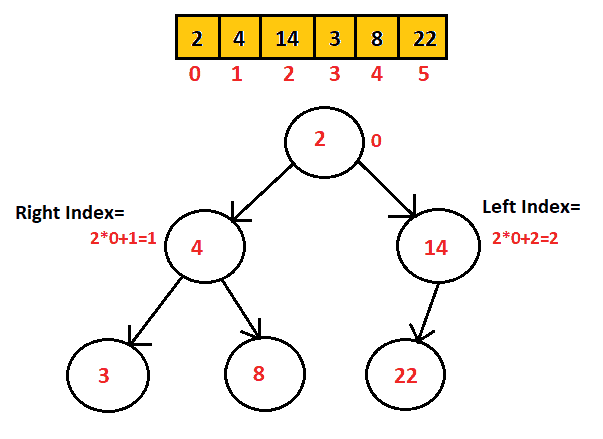
Representation of Binary tree:
Considering the height of a tree be “h“, then:
- Index of left child = 2*(index of its parent)+1
- Index of right child = 2*(index of its parent)+2
Types of heaps:
- Min heap
- Max heap
Min heap and max heap are the binary heaps that represent the ordering of an array.
- Min heap: In this binary heap, the value of the parent node is always greater than its child node.
- Max heap: In this binary heap, the value of the parent node is always less than its child node.
A heap sorting algorithm for increasing order:
- First, create a max Heap from the input array.
- Replace the root element (which has the largest element) with the last element in the array. Then heapify the root of the tree.
- Now repeat the steps until all elements are sorted in an array.
A heap sorting algorithm for decreasing order.
- First, create a min Heap from the input array.
- Replace the root element (which has the smallest element) with the last element in the array. Then heapify the root of the tree.
- Now repeat the steps until all elements are sorted in an array.
Before we begin, you need to have an idea of the following:
Time Complexity of Heap Sort:
- Best case:
0(nlogn) - Average case:
0(nlogn) - Worst case:
0(nlogn)
Java Program to implement heap sort
import java.util.Arrays;

public class HeapSortAlgo
{
  public void sort(int arrA[])
  {
    int size = arrA.length;

    // create heap
    for (int i = size / 2 - 1; i >= 0; i--)
      heapify(arrA, size, i);

    //Replacement of element
    for (int i = size - 1; i >= 0; i--)
    {
      //arrA[0] being max element
      int x = arrA[0];
      arrA[0] = arrA[i];
      arrA[i] = x;

      // call max
      heapify(arrA, i, 0);
    }
  }

  void heapify(int arrA[], int heapSize, int i)
  {
    // Initializing
    int largest = i;
    //Indexes
    int leftChild = 2 *i + 1;
    int rightChild = 2 *i + 2;

    // If left child is larger than root
    if (leftChild < heapSize && arrA[leftChild] > arrA[largest])
      largest = leftChild;

    //if right child is larger than root
    if (rightChild < heapSize && arrA[rightChild] > arrA[largest])
      largest = rightChild;

    // If root is not largest
    if (largest != i)
    {
      int swap = arrA[i];
      arrA[i] = arrA[largest];
      arrA[largest] = swap;

      // Recursive call
      heapify(arrA, heapSize, largest);
    }
  }

  public static void main(String args[])
  {
    int arrA[] = { 6, 23, 9, 15, 4, 1, 11 };

    System.out.println("Array before sorting: " + Arrays.toString(arrA));
    HeapSortAlgo heapSort = new HeapSortAlgo();
    heapSort.sort(arrA);

    System.out.println("Array after heap sort: " + Arrays.toString(arrA));
  }
}
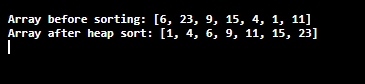
The output of Heap sorting in Java: